AIM For Scale

AIM for Scale and CGIAR Launch Scaling Partnership

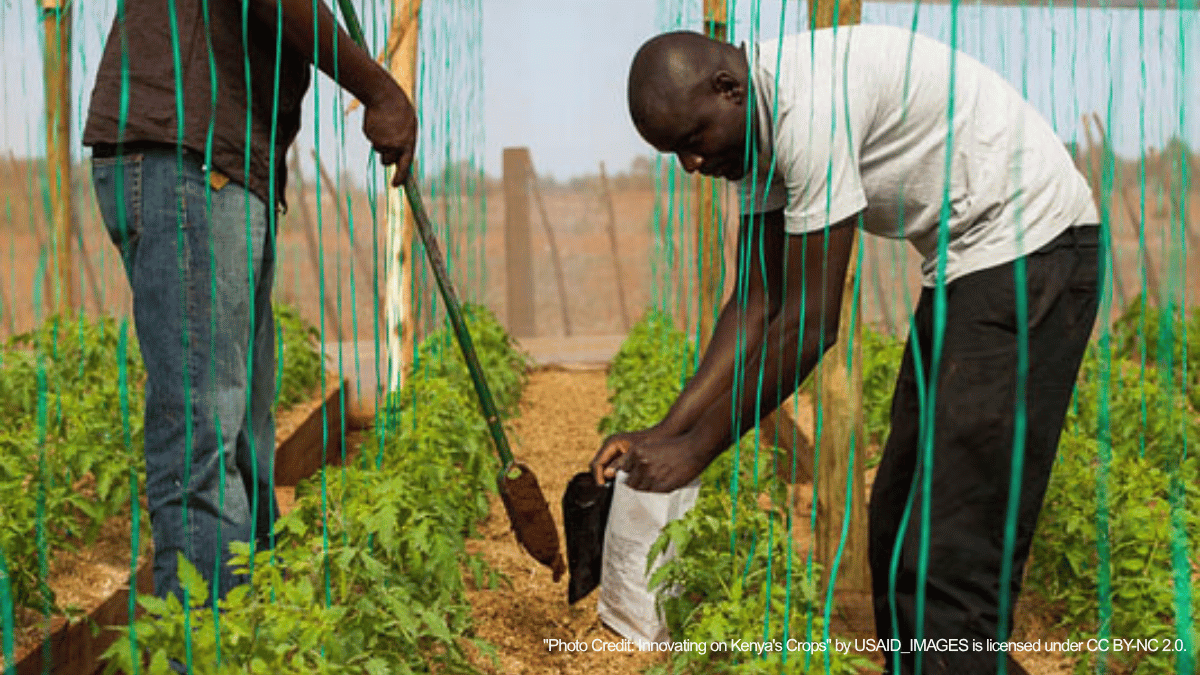
Kenyan farmers with shovels

How do promising agricultural innovations move beyond pilots and reach the farmers who need them most? 

That question framed a recent webinar marking the launch of a partnership between the Agricultural Innovation Mechanism for Scale (AIM for Scale) and CGIAR’s Scaling for Impact Program, with support from the International Affairs Office at the UAE Presidential Court and the Gates Foundation. 

The discussion brought together leaders from government, philanthropy, research, finance and implementation to explore one of the most persistent challenges in agricultural development: not whether solutions exist, but how to make them work at scale, through systems that are sustainable, inclusive and able to improve lives. 

Opening the event, Yaw Nyarko, Professor of Economics at New York University (NYU), NYU Abu Dhabi, and Vice Chair of AIM for Scale’s Advisory Panel, set out the central challenge. Agricultural research has generated ideas, evidence and innovations that can improve farmer livelihoods. But the real test is whether those ideas can reach people in practice. 

“Farmers are waiting for innovations,” he said, reflecting on his work with smallholder farmers in Ghana and elsewhere. The task now is to ensure that research-backed solutions do not remain confined to papers, projects or pilots, but translate into real impact. 

Fatema AlMulla, Senior Specialist of Development at the International Affairs Office at the UAE Presidential Court, described the launch as a milestone in the UAE’s work to strengthen global food security through research, evidence and partnership. 

She noted that AIM for Scale and CGIAR Scaling for Impact share a commitment to translating science into real outcomes for farmers. The partnership brings together CGIAR’s decades of agricultural research, global network and new Scaling for Impact platform with AIM for Scale’s experience working with governments and multilateral development banks to move evidence-backed innovation into national programs. 

Together, they are well placed to answer one of the most important questions in development: how to move from solutions that work in pilots to solutions that reach millions of farmers. 

That ambition is already taking shape in countries including Kenya. Fatema highlighted forthcoming work by AIM for Scale and CGIAR to support Kenya’s meteorological services in scaling weather forecasts for farmers, helping them make better agricultural decisions in the face of climate variability. AIM for Scale Program Director Tobi Baedeker and Alliance of Bioversity International and CIAT Senior Scientist Ani Ghosh went on to elaborate that the collaboration in Kenya will focus on strengthening digital advisory systems more broadly. Building on previous CGIAR work, including that of AICCRA — Accelerating Impacts of CGIAR Climate Research for Africa, the aim is to bring together weather, climate, agronomy, soil and fertilizer information and translate it into practical advice that farmers can receive through channels they already use. 

This means working through national institutions such as Kenya’s meteorological services, KALRO, county extension systems, farmer registries, private sector agri-tech partners and organizations with existing farmer networks. 

Ana Maria Loboguerrero, Director of Adaptive and Equitable Food Systems at the Gates Foundation, placed the partnership in the context of mounting pressure on small-scale farmers. 

Farmers are facing higher input prices, increasing climate variability, El Niño-related shocks and fewer resources to respond. At the same time, she stressed, solutions do exist. CGIAR and its partners have spent decades generating evidence on climate solutions, improved crops, advisory services and other innovations. 

But evidence alone is not enough. 

Ana Maria challenged the partnership to move beyond asking whether a technology can be scaled. Instead, scaling efforts must ask harder questions: for whom does this technology work? Who might be left out? Under what conditions will it succeed? Who will pay? What incentives are needed? And what should be done when evidence suggests the need to adapt, pause or stop? 

For Ana Maria, the value of the new partnership lies in building a more disciplined bridge between research, government systems, finance, markets and last-mile delivery. 

Drawing on her experience with AICCRA she emphasized that innovation must be packaged with the right enabling environment: partnerships, institutions, data systems, finance and feedback loops that allow solutions to work in real contexts. 

She also made a strong call for responsible scaling. Scaling pathways must be clear about benefits and risks, synergies and trade-offs, and possible unintended consequences. They must ask who gains, who may lose, and when evidence requires a change in direction. 

Above all, she said, the partnership must be gender intentional from the start. Women play a major role in agriculture but continue to face barriers in access to land, finance, information and technology. A scaling pathway that ignores these barriers will not truly scale, and may reinforce the inequalities it is trying to solve. 

Sandra Milach, CGIAR Chief Scientist, welcomed the partnership as timely and necessary. Across CGIAR centers and partners, she said, there is no shortage of innovation. The challenge is ensuring these innovations benefit the farmers, communities and food systems facing the greatest pressures from climate change. 

She positioned CGIAR Scaling for Impact as a central part of CGIAR’s 2025–2030 research portfolio: a program designed to connect science, partnerships, finance and delivery so that innovations can move through systems and reach scale. 

Paul Winters, Executive Director of AIM for Scale and Professor at the University of Notre Dame’s Keough School of Global Affairs, explained that AIM for Scale focuses on agricultural innovations where evidence shows strong potential, but where adoption has not yet reached the scale needed. Its priority areas include AI-generated weather forecasts, digital advisory services, livestock productivity, soil health and AI for agriculture. 

Closing the webinar, Timothy Krupnik, Director of CGIAR Scaling for Impact, said scaling must be treated as a discipline. Reach is not the finish line. The deeper question is whether farmers use services to make different decisions on their farms. 

That focus captures the wider ambition of the CGIAR–AIM for Scale partnership: to move beyond generating more knowledge and toward getting knowledge used — in government systems, investment pipelines, advisory platforms and markets. 

Its success will be measured not by the number of pilots launched, but by whether millions of farmers can access, trust, use and benefit from innovations that improve resilience, livelihoods and food systems at scale. 

`
AIM for Scale and CGIAR Scaling for Impact Announce Webinar to Launch Partnership

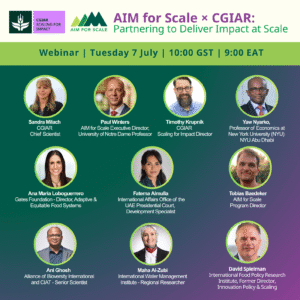
AIM for Scale × CGIAR webinar flyer

AIM for Scale and CGIAR’s Scaling for Impact initiative are pleased to announce the formal launch of a new partnership, to be marked by a public webinar on July 7, 2026.

How do we move from promising solutions to impact at scale for farmers?

This question sits at the heart of both AIM for Scale and CGIAR’s Scaling for Impact initiative. Each is focused on identifying what works, strengthening the evidence base, and—critically—ensuring that evidence-backed solutions are translated into large-scale implementation that improves farmer livelihoods across low- and middle-income countries.

Building on this strong alignment—and with support from the UAE’s International Affairs Office at the Presidential Court and the Gates Foundation—AIM for Scale and CGIAR Scaling for Impact are establishing a partnership to advance their shared mission. This webinar, titled “AIM for Scale × CGIAR: Partnering to Deliver Impact at Scale” will explore what it takes to scale agricultural innovations through governments, multilateral development banks (MDBs), and coordinated partnerships.

The discussion will highlight several core themes shaping both organizations’ work:

  • How governments can serve as the primary pathway for scaling impact
  • Why stronger coordination between technical partners, research institutions, and MDBs is essential
  • Lessons emerging from country implementation in Ethiopia and Kenya
  • How financing mechanisms and innovative approaches—including advance market commitments and other catalytic models—can help accelerate adoption and scale

The webinar will underscore the importance of scaling to meaningfully address food insecurity, highlight the complementary expertise AIM for Scale and CGIAR bring to supporting governments in achieving large-scale results, and explore how this partnership will translate into action on the ground.

The webinar will feature contributions from leaders at AIM for Scale, CGIAR, the UAE International Affairs Office at the Presidential Court, the Gates Foundation, the International Water Management Institute, the International Food Policy Research Institute, the Alliance of Bioversity International and CIAT, and New York University at Abu Dhabi.

The event will take place on July 7, 2026 at 10:00am UAE time / 9:00am Nairobi time.

Registration is open at: https://aimforscalecgiarpartneringtode.splashthat.com/


Asian Development Bank and UAE Sign Technical Cooperation Partnership to Facilitate ADB and AIM for Scale’s Collaboration in Scaling Innovations

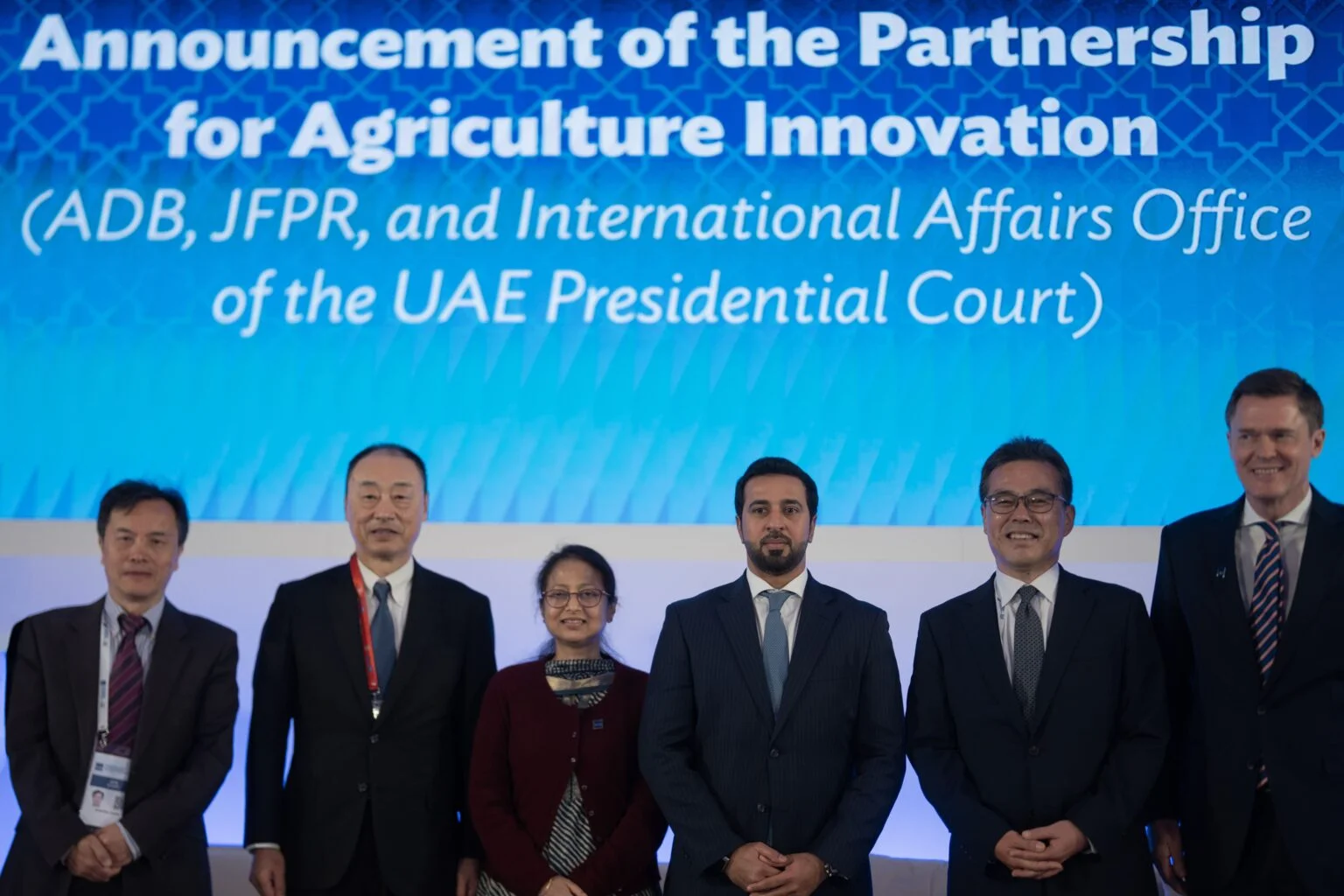
Six officials posing on stage

May 6, 2026 – This week on the sidelines of the ADB’s 59th Annual Meeting in Samarkand, Uzbekistan, the International Affairs Office at the UAE Presidential Court signed a US$1.5 million technical cooperation partnership with the Asian Development Bank (ADB) to scale agricultural innovations for farmers across eight countries in Asia and the Pacific. 

The new partnership will be operationalized by the ADB and AIM for Scale, building on a cooperation arrangement signed between both parties on March 19, 2026. It is part of a broader effort to align technical expertise, government leadership, and multilateral financing around scaling cost-effective agricultural solutions. The agreement is further strengthened by the support of the Japan’s Fund for Prosperous and Resilient Asia and the Pacific (JFPR).

Through this collaboration, AIM for Scale will work alongside ADB and government counterparts in Bangladesh, Indonesia, Nepal, the Philippines, Vietnam, Pakistan, Thailand, and the Maldives to translate evidence-backed innovations into investment-ready programs. These include weather forecasting for farmers, digital advisory services for agriculture, and livestock productivity solutions designed to improve farmer decision-making, productivity, and resilience.

AIM for Scale—supported by the UAE and the Gates Foundation—will provide technical expertise and coordination support to ensure these innovations are effectively embedded within ADB-financed operations and national delivery systems.

“International cooperation continues to play a key role in strengthening global food security,” said Advisor at the International Affairs Office of the UAE Presidential Court Khalfan Al Matrooshi. “Through Abu Dhabi’s AI Ecosystem for Global Agricultural Development, the UAE is convening the partners, expertise, and financing to make that possible. Today’s partnership is a testament to what international cooperation can deliver when global partners come together with shared purpose.”

By combining AIM for Scale’s evidence-first approach with ADB’s financing and country engagement, the partnership aims to close a persistent gap in agricultural development: ensuring that proven innovations reach farmers at the scale required to meaningfully improve livelihoods and food security.

Highlighting the importance of the collaboration, Qingfeng Zhang, Senior Director, Agriculture, Food, Nature, and Rural Development Sector Office at ADB, said: “Digital technologies, innovative financing, and improved fertilizer efficiency are critical to addressing the impact of recent shocks that have made millions more people go hungry, many of them in Asia and the Pacific. Collaborative agreements such as this one act as a catalyst towards integrated agricultural approaches – strengthening input systems, boosting productivity, and accelerating the transition towards more resilient, inclusive, and sustainable food systems”

Shigeo Shimizu, Executive Director representing Japan at the ADB Board of Directors, added: “Through the Japan Fund for Prosperous and Resilient Asia and the Pacific, Japan has been actively supporting initiatives that advance innovation, resilience, and digital transformation across the region. Our support for this initiative since 2024 reflects Japan’s strong and sustained commitment to promoting sustainable agriculture and strengthening food systems through innovation and partnership.”

“We look forward to collaborating with the ADB to ensure that millions of farmers across Asia and the Pacific have access to evidence-backed innovations that can meaningfully strengthen their livelihoods,” said Paul Winters, Executive Director of AIM for Scale. “We are grateful to the UAE and JFPR for enabling this important work.”

AIM for Scale Partners with ADB to Accelerate Scaling of Agricultural Innovations across Asia and the Pacific

Two men behind desk shake hands and hold up documents. There are two men behind them on stage.

Manila, Philippines — March 19, 2026 — The Agricultural Innovation Mechanism for Scale (AIM for Scale) and the Asian Development Bank (ADB) today signed a memorandum of understanding to strengthen collaboration in scaling evidence-based agricultural innovations through ADB-financed programs across Asia and the Pacific.

For millions of farmers, access to timely information, productivity-enhancing solutions, and better services can significantly strengthen livelihoods. Yet too many promising agricultural innovations remain stuck in small pilots, reaching only a fraction of the farmers who could benefit. AIM for Scale–funded by the UAE’s International Affairs Office at the Presidential Court and the Gates Foundation–works to close this gap by identifying evidence-based, cost-effective innovations and assembling the technical expertise, partnerships, and catalytic resources needed to scale them. Through this cooperation, ADB brings its deep country engagement and financing capacity to translate these proven solutions into large-scale investments capable of reaching millions of farmers across Asia and the Pacific.

The agreement establishes a formal framework for cooperation between the two organizations, with the goal of helping governments integrate proven agricultural innovations into large-scale public investments and national development programs.

Under the arrangement, AIM for Scale and ADB will work together to scale high-impact agricultural solutions in areas including weather services for farmers, digital advisory services for agriculture, and innovations that improve livestock productivity, with the potential to expand collaboration into additional innovation areas in the future.

The agreement was signed during the Asia and the Pacific Food Systems Forum at ADB headquarters in Manila as part of a session focused on moving agricultural innovations from research and pilot programs into large-scale implementation.

“ADB is committed to supporting our member countries in transforming food systems and improving farmers’ livelihoods,” said Qingfeng Zhang, Senior Director, Agriculture, Food, Nature, and Rural Development Sector Office, in his opening remarks. “Working with AIM for Scale will help accelerate the adoption of proven innovations and strengthen pathways from research to large-scale investment.”

Nobel laureate Michael Kremer, who chairs AIM for Scale’s Advisory Panel and delivered the keynote address, highlighted the initiative’s focus on translating evidence into large-scale implementation. “AIM for Scale grew out of the work of the Innovation Commission for Climate Change, Food Security, and Agriculture, which identifies innovations with strong evidence of impact and cost-effectiveness. Together with AIM for Scale, we look forward to working closely with ADB to help bring these solutions to scale in the coming years in support of global food security.”

“Achieving meaningful improvements in farmers’ livelihoods requires moving beyond pilots to solutions that reach millions,” said Paul Winters, Executive Director of AIM for Scale. “ADB has long played a leading role in supporting large-scale agricultural transformation across Asia and the Pacific. By partnering with AIM for Scale, ADB is helping ensure that proven innovations are translated into major public investments capable of delivering impact for millions of farmers.”

The cooperation agreement builds on collaboration between the two organizations since 2024 and reflects a growing emphasis among governments and development partners on scaling innovations that deliver measurable improvements in farmer productivity, resilience, and incomes.

Introducing the AIM for Scale 2025 Annual Report

Annual Report Graphic

Scaling agricultural innovations that strengthen the livelihoods of millions of farmers requires more than promising ideas—it requires evidence, coordination, and pathways to large-scale implementation.

Today, we are pleased to share the AIM for Scale 2025 Annual Report, highlighting the progress made over the past year to help governments and partners scale agricultural innovations that work.

The report outlines advances across AIM for Scale’s Innovation Packages, including efforts to expand access to timely, actionable weather forecasts for farmers, advance digital advisory systems that reach farmers at scale, and initiate work on livestock productivity solutions.

It also reflects growing partnerships with governments, research institutions, and development organizations working to translate evidence into large-scale investments capable of reaching millions of farmers.

The past year demonstrated the growing momentum behind scaling agricultural innovations that deliver measurable impact for farmers.

We invite you to explore the AIM for Scale 2025 Annual Report to learn more about the partnerships, innovations, and country engagements shaping this work.

Read the full report HERE.